Wednesday, September 2, 2015

The Myth of the objective review

Logo property of Metacritic.com


I'm back from the Holiday and looking forward to Mario Maker. So lets talk about something completely different.

After reading a not so warm review of Metal Gear Solid 5 and the expectable backlash that followed I thought about it. I have already talked about reviews, not taking them personal, but I think it's time for it once more. With Gamergates one year anniversary just passing and their crusade for a more ethical games media still underway, it's a topic that is as fresh as it was one year ago, when the whole movement started.

Firstly let me say once more, don' take reviews personal. Especially not the scores. The score is the thing that's the most irrelevant in a review. It's just a number, without any meaning. I would love it, if it disappears all together. But this is a vain dream. The vast majority of people still wants an easy way to compare Super Mario to Call of Duty, even if the two aren't comparable in the slightest. And it's a lot easier to only see the 9/10 GTA 5 got and fuss over it, instead of reading the whole review.

But enough of that. There are no objective reviews, because there is hardly any objective press. It's always to a degree subjective. Even with things like tech news, where just the specs of a new device are reported, there is a certain degree of subjectivity. The room you give a specific feature, above some other, is a subjective influence on an objective report. Some reporter may think that the backwards compatibility deserves more room than the online features or the shop, while other think the exact opposite. Not because of malice, but because different people have different viewpoints. Because of that a review of, for example, The Evil Within from a writer, who is not a huge fan of horror games, will be completely different than one from a Shinji Mikami enthusiast. Both are ill suited for writing a review, but because of completely different reasons.

And this doesn't only apply to reviews. The recent Jimquisition talked about this in detail.


Everything around us influences us. So even if you try your best to go to a review or preview event with an open mind it will influence you. This events are carefully crafted spaces to provide you with an optimal experience and later, when you write about it, you will associate this with the game.

Ok so there are no objective reviews and previews. What shall we do then? Forget about them all together? Well of course not. The answer is simple. Ethics and honesty. This not only applies to the classic games media, but especially for Youtubers. Just be honest with your audience. If you were invited to a special preview event for Just Cause 3, which started with a sky dive from a plane onto a luxurious island resort, where you played the game for 3 hours and then relaxed a the pool (this is extremely exaggerated of course) then tell this to your audience, either in front of your Video or article. And not only hidden in the descriptions or at the end. Even the, excuse my words, dumbest idiot in the galaxy and beyond shouldn't be able to miss the information. Hiding it only makes you look bad in the eyes of everyone, when it inevitably comes to light, while telling outright gives your audience a valuable information, which may lead them to have a more critical approach to your piece, which is totally fine. Sponsored content, exclusive preview events and such things are all fine. It's how the industry works (even though I would prefer otherwise). Just don't hide it. Your audience isn't dumb. They'll understand it.

And now lastly lets return to the review in detail. I already told you that I don't really like scores at the end, even though I also do it myself. (Which may or may not change in the future. Still undecided.) A review is always an objective piece from it's author. Some may like the art style of a game, while others call the graphics outdated. Still the goal of every review should be to give a complete as possible overview of the game. Detailing the aspects of gameplay, sound, graphics, controls, design, story and characters. Of course every reviewer will weigh things differently. I, for example, don't delve all too deep into the graphics aspect of a game, because the gameplay is much more important to me. But this is ok. As a customer you should, and can, find the review site, which is most suitable for you in terms of style and weighing of factors, but not certainly the one that agrees with you the most.

And lastly I wanted to share with you the review style I would find the most appealing. It's probably not really feasible, because it takes a lot of time and space. I like the concept of the Famitsu, where four people review a game. I would tone it down a little though. Two people should review a game. Not together, but each for him or herself. They both write a review and can give up to five points. After both reviews are written they come together and have a talk about the game, where they discuss it thoroughly. After all that the reviews are both published, along with the discussion and the score (adding both 5 point scores to create a traditional 10 point one). This kind of dual review, while still not objective of course, would give readers a varied outlook on the game.

In the end there is only this to say. There is no such thing as an objective review. But we still should try to be as objective as possible, while reporting. And we should be honest with our audience. Because our respect is the least they deserve.

And as always

thanks for reading

Monday, August 10, 2015

Mario Maker and the future of 2D Mario

Image Source: Nintendo

I'm pretty hyped for Super Mario Maker, and judging by the reception on the internet, I'm not the only one. Combining the perfect controls of a Mario Game and the limitless creativity of players around the world, will surely create a great selection of memorable levels. (And at least the same amount of junk, but whatever.)

I have often thought about delving into game design and Mario Maker offers me an easy opportunity to try myself as a level designer. The Wii-U Gamepad also offers an easy and intituive way to create levels. One thing I always found off-putting in Little Big Planet was how clunky its editor often felt.

But enough about praising a game that isn't even released yet. I'll leave that to gaming websites and commercials. I want to talk about the impact that Super Mario Maker will have on the Mario Series. At least its 2D iterations.

Like I said above, Super Mario Maker offers nearly limitless opportunities to create levels and the creativity of the community will make sure that this actually happens. That is great and what's even better is, that this will force Nintendo to innovate the series again. Just releasing another game, that essentially is nothing but a level pack, won't cut it anymore. New Super Mario Bros. U was great, and probably the best modern 2D Mario, but it still felt stale. The new Super Mario Bros. Series is reaching a point of franchise fatigue, just like Assasssins Creed or Call of Duty. And now with Super Mario Maker, this won't cut it anymore. Why should I buy a new game for full price, when I can play dozens upon dozens of levels in Mario Maker?

That's why Nintendo will have to shake up the franchise if they want to keep it going. And looking at the sales of these games, they most certainly will. For the first time in over 8 years we may get more than just some new power ups and a world map.

Let's take a look at some of the possibilities. Super Mario 3D World already offered some refreshing alternatives from standard Mario courses. The circus levels, even though I didn't like them, were a great addition. The same goes for the japanese castle theme. But I want to take a look at an older game. A game that really offered fresh worlds that we've never seen in a Mario Game before and ever since.

Super Mario Land 2: The Six Golden Coins for the original Game Boy. It's currently available on the 3DS e-shop so take a look if you want. For anyone not familiar with this game, let me explain. It marked the debut off Wario, who took residence in Marios Castle, while he was away saving Princess Daisy during the events of Super Mario Land. Yes apparently Mario has castle. I guess in the end Peach gave him more than just a cake. But let's return to the game before we drift to far into Rule 34 territory. To regain access to his castle Mario has to find 6 Golden Coins scattered across the island. This takes him to six distinct worlds, which are unlike any he has seen so far.

Image source: http://tibots.deviantart.com/art/Super-Mario-Land-2-323274559

First of we have the Turtle Zone, which starts with a standard beach level, before entering a sunken submarine and finally the belly of a giant whale.

Then there is the Mario Zone, which basically is a giant Mario robot. You'll enter through his foot and fight your way up to his brain, avoiding screws, tin soldiers, cranes and conveyor belts.

Next up is the Pumpkin Zone. After besting a graveyard full of walking strawberrys with knives int heir heads, japanese Demons (Oni) and other dangers, Mario enters a witch's cottage.

There is also the Makro Zone. This is a simple, normal house. However, Mario is shrunk to the size of an ant. The first level even takes place in the garden outside the house with lot's of ant enemies. Then you'll battle yourself across the ground floor, before ascending to the attic through the chimney.

And if you're too bored down on boring old earth you can take a trip to space. First you have to deal with reduced gravity, while walking on the surface of the moon, before jumping into outer space and float towards victory. Even the final boss of the previous game returns for a brief intermezzo.

And finally there is the Tree Zone. Ascend a giant tree. First through it's branches and then either across it's leaves or through a beehive.

All of these Zones offer other gameplay ideas and different enemies, never before seen in a Mario game. Also Wario was a nice change from the usual Bowser monotony. He was even the first to use Marios Power ups against him in a pretty cool boss battle.

Image Source: Nintendo

The World Map was another strong point of the game. You didn't need to beat the 6 Worlds in any prescribed order. You could freely choose which one to tackle next. Some levels even had hidden exits, which let you skip some or took you to a bonus level. And in the Tree Zone you could choose which level you wanted to play to reach the top. All this combined offered a amount of freedom, which I truly found refreshing.

Of course there were problems, like the overall simplicity of the game. And it was pretty easy. But for me Mario (at least 2D) never reached this kind of variety ever again.

And that's what I hope Nintendo will return to after Mario Maker. Just giving us the same Grassland, Desert, Water, Snow, Forrest, Mountains, Clouds, Lava Word Design again and again won't cut it anymore. They really need to come up with some crazy new designs to justify another entry in the New Series.

Also it doesn't have to be restricted to just Level scenery. They also can change up the gameplay, which in return will have a huge effect on the level design. They could, for example, make the background more interactive, have Mario shift between two planes of existence or something we couldn't even dream off.
Of course there is the danger of loosing the Mario essence of great level design and perfect controlls a long those lines, but I trust Nintendo enough for them to not let that happen.

All in all I think that Mario Maker is a great package for Nintendo fans. Not only do we get a great game, with nearly limitless potential, but it also forces Nintendo to refocus and innovate the 2D Mario franchise. In the worst case the just won't do new 2D Marios, but at least that frees capacities to work on other franchises.

So for me Super Mario Maker is a complete win on all accounts. But what is your opinion? Do you share my hopes for the future of 2D Marios? What new features or scenarios would you love to see in New Super Mario Bros. NX?

And as always

thanks for reading

Tuesday, July 28, 2015

Zelda U Ideas


So there was an interesting leak about Zelda U on Zelda Europe the other week. And no matter if you believe it or not, it got me thinking. What do I expect from a next gen Zelda game?

Well if you want to get up to date on the leak then you can read it here in german:


also did an excellent English translation.

Everything in this leak sound good, and more important, believable. Even though a Q4 2016 release sucks, it makes sense. This way Zelda U will be a last swan song for the unappreciated Wii-U and an port for the NX (if the system launches in that time frame) is also possible.

But this leak also got me thinking. It seems that they are still facing the empty world problem from Twilight Princess and (to a degree) Wind Waker and I truly hope the can fix it. A believable open world it something I'm still missing from many games. And I hope they leave some loneliness. I think I said it once in an earlier post. The Gerudo Desert in Twilight Princess is perfect the way it its. The loneliness creates a great sense of immersion for me. The Problem is just that the rest of the world feels the same. But this empty world syndrome is a problem, which can't be really discussed. Either they solve it or they don't.


I want to focus on something different. Earlier this year I read an interesting ''leak'' for Zelda U. It was obviously fake, but it had some nice ideas, which I thought would have some potential, if expanded upon.

The leak was mostly talking about the story. In this iteration Link would be an adventurer and tinkerer that explores a mostly uncharted Hyrule. There wouldn't be a kingdom, only some small self contained village communities. Zelda would appear as leader of a gang of Gerudo mercenaries with Ganondorf as her second in command. The game should revolve around the theme of destiny and what we can do to change it. It was a nice read, but only posted on an anonymous image board and all in all not very believable.

However the part about Link got me intrigued. I'm a huge fan of the item System in a Link between Worlds, and this tinkerer approach could help recreate this in Zelda U. Aonuma said that the intend to start the puzzle solving with the decision of your next objective. How do you get there? How do you solve the challenges the destination confronts you with?
An item system like in a Link between Worlds could immensely help with that. But how would the integrate it? Just another Shop like Ravios?
Well that is when the tinkerer idea comes into play. Link builds his weapons himself this time. Each weapon needs different materials to craft. So in this case you'd have to choose if you build the Hammer, which needs a forge, steel and so on, or the Hookshot, which also needs steel, but also oil and other components. By having some items need the same materials, you'd force the player to choose. This way you couldn't craft all weapons at the beginning, but really had to decide which one fits your playstyle the most. Gathering these materials creates an incentive to venture out int the world and explore.
Upgrading could also be done in a similar way. Across the world, in dungeons, towns and caves Link could find blueprints, which allow him to upgrade the weapons, creating another layer of individuality. Do you want to upgrade your Bow or craft the Boomerang.

I tremendously enjoyed the freedom in a Link between Worlds, but it also was to easy to get all items early. There should have been a little more difficulty to it, thus creating the need to choose your items carefully.

This is what I hope getting from Zelda U.

Apart from that everything the leak from Zelda Europe sounds believable. Zelda U as kind of a best of makes sense, and I hope they utilize the longer development time and create a great open world.

What are your thoughts about the leak or Zelda U in general?

And as always
thanks for reading

source of both pictures: Nintendo

Monday, July 20, 2015

Procedural Generation

Picture Source: Hello Games


If there is one game on other Platforms that I'm genuinely hyped for than it's No Mans Sky. The game from British developer Hello Games, known for their Joe Danger titles, is going to let players explore a gigantic Universe. Over 18 quintillion possible planets, or to put it simply, more than you could explore in a lifetime. How this is possible you ask? Well Procedural Generation makes it possible. So lets talk about this technique and (maybe) how Nintendo could use it in its games.

And one more thing. I'll take a look at the use of Procedural Generation in creating gaming content. Things like Levels, Environment, Characters, etc. and not it's use in creating game logics, mechanics and so on.

Procedural Generation means that content can be generated through an algorithm by the computer rather than manually. It requires none (or barely any) human input. This gives the game designer many new possibilities, which he wouldn't have without this tool. It has been used by different games throughout the history. The Elder Scrolls 2: Daggerfall took place in a procedural generated world, roughly the size of the British isles. While Soldier of Fortune used the technology to create diverse and randomized enemies. Procedural Generation is a tool, which can be used to augment the creativity of human designers and allows for things, that wouldn't otherwise be possible.

There are two ways of integrating Procedural Generation into your game. The first is during the actual development of the game. This, for example, makes bigger game worlds possible, without increasing development time.
The other use is while actually playing the game. Randomizing levels, dungeons or encounters with every new start, helps keeping things fresh. This way of incorporating Procedural Generation into your game was used a lot in the 80s.

In the early days Procedural Generation was used to overcome storage problems. There wasn't enough space for huge worlds, but with Procedural Generation Designer managed to overcome this. By storing only the seed data on the disks the could fit in huge worlds, which were generated procedurally by the User PCs.
Seed data refers to the basic set of information which the algorithm in your game then uses to procedurally generate it's content. Most of you probably got in touch with this through Minecraft, where you can enter a seed for your world, from which it is then created.


Minecraft isn't the only game in recent time, which uses Procedural Generation. There are many games that use it in one way or the other. From big budget titles, such as Diablo 3, to smaller indie games, like Spelunky. But instead of storage problems, like in the early days, today there are other reasons for the use of this technique.

It can speed up content creation by a huge margin, enabling new possibilities and chances for designers to work on creative ideas.
On the other hand it can keep games fresh, by randomizing several aspects of them.

Of course it also has drawbacks. With a bad algorithm you may create impossible or unsolvable levels. Think of dungeon without exit or entrance. And it can easily create chaotic levels without any sense.

One of the biggest flaws of Procedural Generation is story telling. If you take a look at the most successful titles, which use the technique, none of them is story driven. Others may say that titles like No Mans Sky and Minecraft offer the player the chance to experience his own story, and I would definitely agree, but a story driven game in the classical sense is still out of reach for Procedural Generation, because randomness is the last thing you want in one of these.

So now lets take a look of how this technique could be used in Nintendo Games.


2D Marios seem like a good place to start. With Procedural Generation Nintendo could create a nearly infinite amount of levels for these games. It is definite a thing they should think about. The question that remains however, is if this levels then can compete. Mario levels often are more than just an assortment of pits and enemies. They are, from a game designers standpoints, masterpieces. Just take a look at Shigeru Miyamoto explaining the first level of the original Super Mario Bros.


Or just take a look at the levels of Donkey Kong Country: Tropical Freeze. Just watch a speed run of one of them. It truly shows the perfect level design, which went into those levels.

Creating such things through Procedural Generation would be really hard, and that is why I think it hasn't been used much in this genre.


Zelda has already used the technique in Four Swords, and maybe they could use it again in Tri Force Heroes. But what about the main line Zelda games? Well it could be used to create the overworld or even the dungeons. While I'm not a fan of dungeons created through Procedural Generation, as they often lack the deepth that can be achieved through human designers, a procedurally generated overworld could be interesting.


It already has been used to an extent in Mario Kart. Excite Bike Stadium is procedurally generated for each race, and I think that is an angle that could definitely be explored more. F-Zero would be a great candidate for procedurally generated courses and it would definitely fit with the futuristic angle of the series. A good mix between courses which are randomized every time and classic ones could be great.


But all in all I don't think Nintendo games would be a good fit for Procedural Generation. Their approach to designing doesn't mash well with this technique. Still it poses a huge potential for the future, and I'm looking forward to new ways of using this technology in game design.

And as always
thanks for reading


Tuesday, July 7, 2015

Yoshis Wooly World Review


Overview:

If there is one developer that live their name, then it's Good Feel. The creators of Kirbys Epic Yarn and the under appreciated Wario: The Shake Dimension are experts in making games that just... feel good. So can their newest project live up to that legacy?
Yoshis Wooly World was announced in early 2013 in a Nintendo Direct. But it took nearly one and a half years till we first got to see it and then another year (for us lucky few in europe) till it arrived on the store shelves.

Story:

Like most Nintendo Games Yoshis Wooly World overs a very simple and light story. The Yoshis are living happily on Craft Island, but one day Kamek suddenly appears. He turns all the Yoshis into Wonder Wool, except two. These two Yoshis now have to rescue their brothers and foil Kameks plans.

Gameplay:

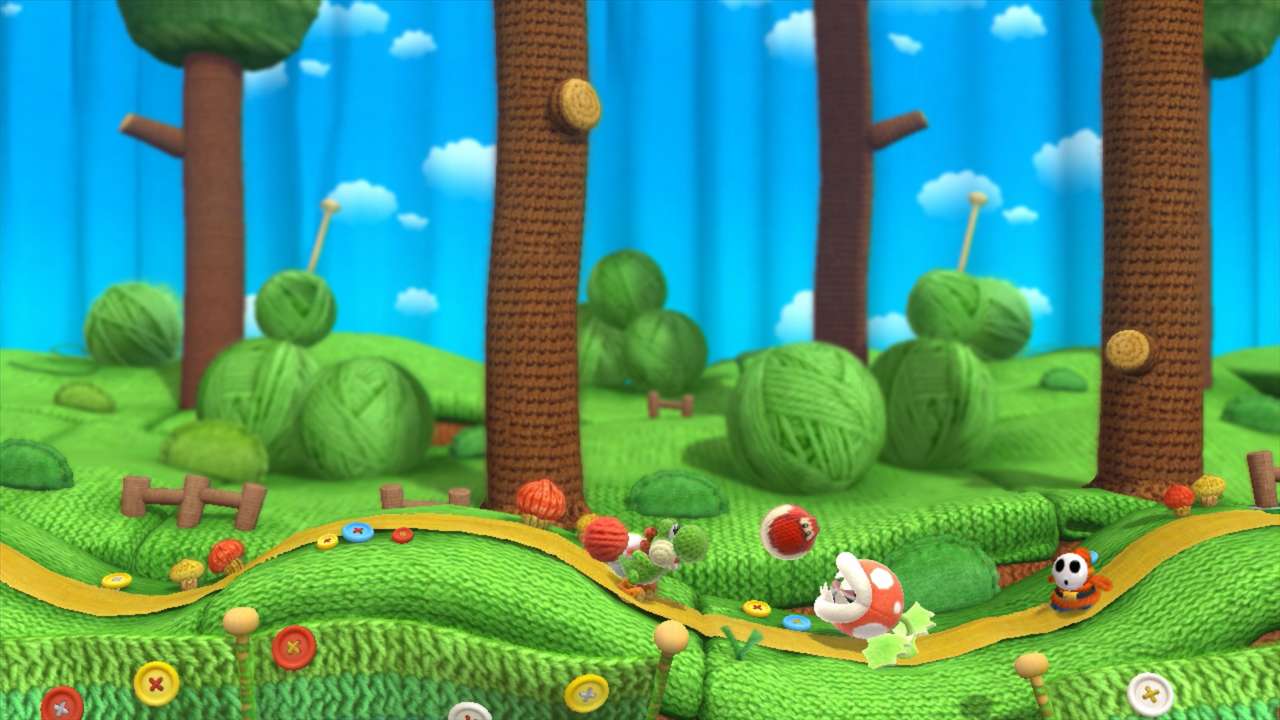
Yoshis Wooly World is a spiritual successor to two games. Yoshis Island and Kirbys Epic Yarn. While the presentation is obviously from the latter, most of the game play is directly taken from the Super Nintendo classic.


Yoshi still has all of his abilities from his debut, but he also didn't really expand on them. He still eats his enemies and turns them into eggs, which serve as ammunition. He also possess his flutter jump ability, which allows him to cover large gaps and distances. Different colored melons let him spit fire, ice or simple seeds at his enemies. Everything is just like over 20 years ago. Yoshi also still has the ability to transform into various things, like Mermaid-Yoshi, Plane-Yoshi, etc. Controlling Yoshi also feels just like in the good old days. The platforming can be very demanding (especially in later worlds) and so precise handling of Yoshi is mandatory.

So then what's different? Well firstly you don't have to carry Baby Mario around any more. So no more crying. Instead Yoshi now has a simple health bar, shown through hearts. At full health the green (or whatever strange color combination you give him) dinosaur can take up to five hits from enemies. Lava and Spikes however, are still a One Hit KO.


And of course there is the obvious thing. Everything looks like it's hand crafted out of different materials. Mainly wool of course, but some enemies and environments also incorporate other things like leather.

In Kirbys Epic Yarn the whole game was fully 2D, while this time everything is 3D, moving in a 2D Plane. Just like Donkey Kong Country Returns: Tropical Freeze for example. Good Feel made sure that every level looks like it's created from hand. As if it could be easily rebuild on in your own room. And the succeed with this pretty well. But what does the wool aspect bring to the gameplay?

Not as much as I would have hoped. You can use Yoshis Tongue to unravel things and his wool eggs to create new platforms. One of the most innovative uses is the stuffing of enemies. Enemies, which are made out of wire, can be stuffed with your yarn, turning them into objects or plattforms. Sadly this get's used only in three levels and doesn't have a lasting impact on the gameplay.

But it can't be denied, that the game looks really great. Just from a gameplay perspective I think there could have been done more with the Wool theme.
The level design, however, fully utilizes the graphics aspect. In the six worlds you'll find plenty of unique and different levels. Nearly every level has it's own gimmick that makes it stand out. Be it a labyrinth inside a pyramid, a raft tour through the jungle or conquering a ghost house full of spooky fabric. No level is the same and nearly every one of them also has it's own soundtrack.

The same variation can be applied to the enemies. They're mostly already known adversaries of Yoshi, but the Yarn look gives all of them a fresh twist.


Also, just like in in Donkey Kong, you have an infinite amount of time to explore the levels, which fully allows you to enjoy the detail put in every stage. And you should always take a second look, if you want to make sure not to miss a thing. Every level is filled to the brim with collectibles, most of the already known from predecessors. Coins have been replaced by gems, but like in the older games 20 of them are unique. Instead of red coins it's Stamp Marks this time around. Collecting them unlocks different Stamps for you to use in Miiverse posts. The flowers also didn't change. Five of them are hidden throughout each level. Finding them unlocks two things. Firstly the chance for a bonus game, if you manage to catch a flower when jumping through the goal ring, and by collecting all flowers in a world you unlock a especially hard level. These levels are designed to test you to your limit, and also contain the same collectibles as the standard ones.

A completely new collectible are the wonder wools. Like with the flowers, five of them are hidden throughout each level. Collecting all of them rewards you with a new skin for your Yoshi. Gotta catch collect them all.

And lastly there are hearts. For 100% you have to finish every level with 20 hearts remaining. That's easier said then done. Hearts can be refilled by two means. Collecting them after shooting down a winged cloud or by passing a checkpoint. When you die you'll start over with 10 hearts, and if you're a the last checkpoint it's often impossible to reach 20 hearts from there. So this adds another challenge to the levels.


In any case Yoshi has a pretty good difficulty curve. There are hardly and spikes or drops, but the game rises the challenge in a consistent way. Just finishing the levels can be done with a little bit of time and skill, but collecting everything is a completely different story. But if the game still is to challenging you can always switch to mellow mode. Here Yoshi has wings and can infinitely flutter through the levels. You can't finish any bonus tasks this way however.

Another help are different patches. Before each level you can use one of them against a small fee. This patches are unlocked after you beat different bosses and have unique effects. One may spawn lots of fire melons throughout the level, while another allows Yoshi to collect items with his tongue. This allows for many interesting ways to approach difficult levels. Only one patch can be equipped however.

Lastly there are two things to talk about. Multiplayer and Amiibos.

The Multiplayer in Yoshis Wooly World is pretty much the same as in other 2D Platformers from Nintendo. It is really fund, but to effectively work together you need some strong nerves. One Yoshi can eat the other and turn him into an egg. For example, by shooting his partner the team can then access new areas. However, abusing this is easier than using it wisely and often happens on accident... the first few times at least. Still it's a nice little feature, but once again it only works local. If you want to play online Co-op with a friend far away, you're (once again) out of luck. Also some of the harder stages are clearly made with only one player in mind.

Amiibos are also on board. Nintendo even produced special Yarn Amiibos for the game, which are harder to get then job in this economy. By tapping a compatible Amiibo onto the game pad you unlock a unique Yoshi look based on the used Amiibo. And if you use a Yoshi Amiibo, you'll unlock a second Yoshi, who mirrors all of your actions, enabling Co-op for single players. All in all Amiibos are very well used in this game, enhancing and enriching the game play without feeling invasive, like in Splatoon for example.


Presentation:

Presentation wise this game is pure sugar. Everything looks adorable and hand made. Each level is full of details and creativity. It's a great example of Art Style over raw horse power. Yoshis countless animations, be it him getting scared in a ghost house or nearly falling of a ledge, just speak to the player. Sadly the game sometimes stutters or slows down when lot's of action is going on. Also the load times are really high sometimes.


Music Wise Good feel once again drew upon their creativity. Just like in Wario Land: The Shake Dimension nearly every level has it's own soundtrack. Each of them fitting and sometimes even surprising. Hard guitar riffs during an intense lava level are definitely fitting.

All in all the presentation is a really strong point of Yoshis Wooly World, only slightly damped because it's rough around the edges.


Bonusround or the game after the game:

Spoiler Warning:

Finishing all six worlds and beating the final boss, unlocks the Boss tent. There you'll fight against sped up versions of the bosses and unlock three additional Yoshi skins.

There is also the Yoshi Tent and the Amiibo Tent, where you can choose between all your unlocked Yoshi skins.

And finally there is the museum tent. Here you can take a look at all enemies in the game and listen to all the music tracks.

Also there are the six S-levels, which are extremely challenging.


Conclusion:


Many call it the best Yoshi Game since his debut as main star in Yoshis Island, and I can wholeheartedly agree. Controlling Yoshi just feels as precise as it did all these years ago. The levels are overflowing with creativity and the wool centric aspect of the game is incorporated rather well. It could have been more, but still. Tons of collectibles add even more challenge to the levels and are a lot of fun to hunt for. With Mellow mode and the different patches, difficulty can be freely adjusted. All in all Yoshis Wooly World is another great 2D Jump'n'Run for the Wii-U.

+ Unique, colorful and charming visuals with lots of detail
+ Good old Yoshi Gameplay
+ Challenging and varied level design
+ Great music

- Nothing really new gameplay wise
- Wool elements could have been used more

8/10
source of all pictures: Nintendo